Embodied andragogy is a teaching discipline that incorporates the body as a necessary component of learning, in contrast to other approaches that traditionally rely primarily on the mind and cognition. Experiential learning can be understood as a tool of embodied andragogy that has the potential to facilitate creativity, reflection, and real-world application (Dewey, 1938; Morris & Bilich-Eric, 2017). However, these strategies are often designed for small, white, able-bodied students and faculty, ignoring the complexities of bodies, particularly those that are marginalized (Dolmage, 2017). By combining elements of universal design (UD) and experiential learning into the classroom setting, counselor educators can invite in the experiences of all bodies, creating the space for integrated, holistic learning experiences.
As counselor educators, we have a wide range of competencies and standards our programs need to meet, which UD and experiential learning can bolster. For example, in the 2024 CACREP standards, when referring to the Learning Environment, Section 1, Standard K states, “the academic unit makes continuous and systematic efforts to attract, enroll, and retain a diverse group of students and to create and support an inclusive learning community,” (para. 11). The purpose of this study is to bring body ableism to the forefront of conversations about what it means to be a diverse learning community, offering tangible strategies for supporting inclusive learning for students with apparent and non-apparent disabilities. The authors have coined the term body ableism to highlight how oppression towards disabled people encapsulates bias towards people’s bodies and therefore intersects with other forms of oppression such as racism and sizeism.
To begin to explore these topics, we presented an educational workshop on inclusive embodied andragogies at the 2023 Association for Counselor Education and Supervision (ACES) conference and collected data from workshop participants. The findings are presented in this paper to provide a deeper understanding of the need for accessibility in experiential learning.
Experiential Education
Growth as a therapist develops because of multiple factors, including both personal discovery and accumulated experience, all held within a container of ongoing learning from predecessors in the field (Skovholt & Jennings, 2004). Historically, information in North American contexts has been imparted by these predecessors through the practice of pedagogy, or the art and science of teaching children (Knowles, 1988). A pedagogical approach emphasizes content and places the learner in a dependent role, with a heavy emphasis on transmittal techniques and a lesser emphasis on the experience of each learner. Pedagogy can be contrasted with Eduard Lindeman’s concept of andragogy, first introduced in 1926 and known as the art and science of teaching adults (Merriam & Bierema, 2014). While pedagogical and andragogical approaches exist on a spectrum, andragogy—process-based, developmental, and emphasizing the inherent wisdom of the learner—has become a preferred methodology for educators working with adult learners (Knowles, 1988; Merriam & Bierema, 2014).
In their text, Merriam & Bierema (2014) discussed the importance of the integration of both body and spirit in the learning process, referring to these as “nonrational modes” and stating that, over the past two decades, these “have been attended to as legitimate pathways for learning” (p. 128). These nonrational modes consider the whole person of the learner. Feminist scholars and the field of neuroscience have helped to bring attention back to the embodied experience, and yet education has struggled to consistently return to the body as a space and site for learning (Merriam & Bierema, 2014, p. 129). Research has shown that our earliest forms of knowing are preverbal, and even as adults we use both nonverbal and verbal experiences to integrate and assimilate knowledge into ourselves (Merriam & Bierema, 2014; Siegel, 2020).
Sadly, the value of an integrated, embodied approach is oftentimes underutilized in higher education. One byproduct of this undervaluing is that many educators and students are taught to ignore their bodies in the classroom. This tendency sits in tension with both integrative andragogical approaches and dance/movement therapy (DMT), including DMT education, where embodiment has been long understood as a pathway to emphasizing the body and approaching knowing (LeFeber et al., 2023; Meekums, 2013).
Dance/Movement Therapy
Although dance has been used as a healing practice for thousands of years, the field of dance/movement therapy emerged in a codified form in the United States during the 1940s. Dance/movement therapy belongs in the expressive arts therapies family, under the larger umbrella of counseling and mental health therapies. As described by the American Dance Therapy Association (ADTA), DMT is “the psychotherapeutic use of movement to promote emotional, social, cognitive, and physical integration of the individual” (ADTA, 2025, p. para. 1). At its core, DMT examines the correlation between movement and emotion. The field stands out due to an emphasis on embodiment as a primary medium for growth and healing, emphasizing both the psychotherapeutic value of dance and the role of movement in expressive communication (Lauffenburger, 2020).
Several studies have demonstrated the impact of dance as a combined intervention for both physical and cognitive development, particularly in the realm of neurorehabilitation (Demers et al., 2015; Dhami et al., 2015; Lee & Ko, 2023). Dancing implicitly encourages multi-modal engagement, including not only physical movement but also cognitive functions such as memory, perception, motor skills, executive function, and emotion (Dhami et al., 2015). However, the clinician’s knowledge and skills in incorporating dance and movement have been shown to be both a barrier and/or facilitator of learning, underscoring the importance of education in this area to foster the development of embodied understanding (Demers et al., 2015). Within therapeutic settings, there has been an increase in both awareness of and popularity around the impact of embodied approaches over the past several decades, as clinicians lean into somatic interventions and approaches. As a long-standing discipline, DMT offers a unique vantage point in these conversations, with a history rich in understanding the therapeutic impact through both an emphasis on nonverbal communication and healing, as well as the potential for growth inherent in the promotion of creative expression (Lauffenburger, 2020).
Embodiment in Counselor Education
An understanding of the value of embodied experiences as integral to healing can be extended to the education of counselors in training. The bodies we each have and therefore bring into the classroom become the vehicle for our learning. Morris and Bilich-Eric (2017) asserted that experiential learning in psychological supervision is “central” in developing competencies (p. 104). Similarly, Paul (2021), summarizing recent peer-reviewed studies linking movement to increased memory and cognitive functioning, asserted “the field of embodied cognition has produced persuasive evidence that our thoughts – even, or especially those abstract or symbolic in nature – are powerfully shaped by the way we move our bodies” (p. 53). Hence, embodied, experiential learning is understood to assist in the development of the applied skills necessary for both counseling and supervision practice (Beardall et al., 2016; Hrach, 2021; Lauffenburger, 2020; Millrod et al., 2021; Young, 2017).
Experiential learning entails a cycle of relating learned content to real-life situations, which allows students to further apply the embodied knowledge gained in diverse settings (Dewey, 1938). For educators and students with visible disabilities, along with other identities such as race and gender, the choice to hide their body or their identity is not an option. The influence of identities often becomes reflected in the andragogical approaches educators select. This, in turn, is reflected in students and how they are invited to bring their embodied selves into the classroom setting.
Bodies in and of themselves are andragogical, and we must learn as educators how to make space for our own embodied experiences, as well as the diversity of embodied experiences represented by our students (Ambuter, 2019). By inviting somatic and embodied practices into the classroom as one component of experiential learning, students can be reminded that we do not simply have bodies; rather, we are bodies, and we bring those bodies along with us into all the work we do with clients. While this approach may uniquely reach and empower students, integrating UD into counselor education may further provide avenues for meeting unique needs and accommodating a diverse student body.
Universal Design
The purpose of UD is to create an environment that can be accessed by the most people possible (Burgstahler, 2020). Though UD is typically thought of in relation to physical accessibility (e.g., ramps, wide aisles), it also includes cognitive accessibility (e.g., using simple terminology) and social accessibility (e.g., being a welcoming space to people with disabilities). Burgstahler (2020) separates these into seven core principles of UD: equitable use, flexibility in use, simple and intuitive use, perceptible information, tolerance for error, low physical effort, and size and space. Considering these components, UD makes environments more accessible for folks with and without disabilities. For example, a ramp can make a building accessible for people who use a wheelchair, while also increasing accessibility for people pushing a stroller or making deliveries. While UD is not a perfect model, it can benefit all users when applied well.
UD philosophies have been applied to various settings, including education. The use of UD in K-12 education has since led to the application of UD to broader academic spaces (Burgstahler, 2020) and the development of organizations such as The Center for Universal Design in Education (DO-IT Center, n.d.). However, to the authors’ knowledge, how UD can influence embodied andragogical practices within counselor education has not yet been analyzed, despite growing knowledge of the importance of the body in the classroom.
Accessibility in Higher Education
As much as challenges remain, accessibility in education has come a long way. Historically, people with disabilities were hidden from society through movements like institutionalization and eugenics, which forced people with disabilities to live out of the public view and stripped away their autonomy. To push against this segregation, the Disability Rights Movement emerged in the 1970s, leading to legislative changes to protect disabled people better, such as Section 504, the Individuals with Disabilities Education Act (IDEA), and the Americans with Disabilities Act (ADA). The creation of UD was also heavily influenced by this legislation arising in the late 20th and early 21st centuries. Our understanding and experience of disability today continue to be heavily influenced by the values that came out of eugenics, anti-Blackness, and colonialism, such as productivity and desirability (Lewis, 2022).
Many of these legislative protections for disabled people are within the context of K-12 education, making it challenging to apply them in higher education. In K-12 education, disabled students often have a team advocating for services for them through policies such as Section 504 and the IDEA. However, when students enter college, they are suddenly expected to advocate for themselves (Lund et al., 2016). When the ADA was established, disability offices were gradually implemented on college campuses to provide accommodations for disabled students “within reason” (Americans with Disabilities Act of 1990, 1990). Formalized accommodation processes have benefits, such as requiring follow-through from professors (Abes & Darkow, 2020), but can also add significant expenses and time commitments for students to receive medical evidence of their disability (Axelrod et al., 2019; Krebs, 2019).
This framing helps situate why UD principles may not be as widely applied in higher education. With this study, we aim to encourage the expansion of teaching methods not often utilized with marginalized populations in mind. By leaning on the values of non-prescriptive representation and expression (Burgstahler, 2020), we offer how being attentive to bodies and minds in experiential activities can create more positive learning experiences for students. Like how a ramp benefits people with and without disabilities, combining UD and experiential learning principles allows greater access to learning for students with disabilities as well as naturally incorporates elements of other person-centered approaches, such as trauma-informed care.
Three constructs integral to our understanding of accessibility in higher education are ableism, internalized ableism, and academic ableism. Ableism is oppression toward disabled people based on societal biases toward able-bodiedness and able-mindedness (Bogart & Dunn, 2019; Lewis, 2022; Schalk, 2017); internalized ableism is when people subconsciously begin to believe these societal messages about themselves. For the scope of our paper, it is imperative to understand how ableism acts in the academy. Academic ableism is about how the values and norms in academia impact conceptions of disability and, consequently, impact students, faculty, and employees with disabilities (Dolmage, 2017). No matter the form, ableism can leave a lasting impact on one’s day-to-day experiences and comfort in the workplace, and cannot be understood as a single entity, but rather as an interaction with all forms of oppression (Fuentes et al., 2023; Hays, 2024).
This study aims to put ableism into conversation with what it means to facilitate a diverse learning community. We offer tangible strategies, highlighting participant responses, to support inclusive learning for students with apparent and non-apparent disabilities, acknowledging the importance of bringing the body into the classroom. By offering a combined UD and experiential learning perspective, we invite counselor educators to consider the experiences of all bodies, leading to more inclusive and holistic learning experiences.
Methods
As educators, our investment in this work and commitment to accessibility in classroom settings spans our work in both face-to-face and remote counselor education and supervision programs. As authors, in sharing our common experiences, we hoped to share our learnings with a wider audience of similarly situated colleagues, hoping that our collective wisdom would help us further understand the need for accessible embodied andragogies, while also expanding our own scope of what these practices might all include.
Positionality Statement
As counselor educators, we (Roundtree & LeFeber) recognize the impact of our positionality on the research process. As women in academia, we each have personal experiences of sexist microaggressions from colleagues and students, while also having power as white women in the academy. Both of us present as able-bodied, though we have varying experiences with disability. I (Roundtree) identify as disabled and have been actively involved in the disability community for over 20 years, five of those years working as a clinical rehabilitation counselor and professor. My disabilities are non-apparent and include chronic pain and mobility limitations. I (LeFeber) identify as temporarily able-bodied, while also being acutely aware of the changes inherent in an aging body, as well as having a chronic visual condition that is currently treatable. Professionally, I have done clinical work over the past two decades, emphasizing support for those in the disability community.
Workshop as Research Method
With these goals in mind, we created and planned an educational workshop on the topic of embodied andragogies for all bodies for the ACES conference, held in Denver, Colorado, in October 2023. In designing the workshop, we intentionally built interactive opportunities for participants, hoping that gathering data from the workshop participants would give us a deeper understanding of both the need for accessibility in experiential learning as well as other approaches taken to ensure this for students.
The ACES conferences are held on a bi-annual basis and seek to “highlight research and best practices in supervision and in the training of counselors” (ACES, n.d., p. para. 3). These conferences are attended by counselors, graduate students, supervisors, and faculty members. Ørngreen and Levinsen (2017) suggested that professional workshops, such as the ACES conference, can be utilized as a method for research that can, in turn, inform learning design, best organizational practices, and the learning domain. Osborn (1953) originated the term “workshop,” describing it as a method for creative problem solving done in group settings. Conferences and workshops serve a variety of purposes, but when the collective wisdom from participants is considered, a research workshop has the potential to produce valid and reliable data about the subject area in question (Ørngreen & Levinsen, 2017). The hope for involving participant feedback in this workshop was to produce further information on how to foster accessibility and inclusion in counseling education settings.
Prior to the workshop, we prepared the content for the didactic portion of the conference workshop. This included an introduction where we also provided some informed consent for the participants, explaining that we hoped to gather information from participants to expand our knowledge around the topic at hand. Next, we invited participants to engage in an experiential check-in, referencing a feeling/sensation wheel and taking note of what each of their bodies needed to attend well to the topic(s), including an invitation to take action steps towards meeting those needs before proceeding. Following this intrapersonal self-reflection, we outlined the three learning objectives for the workshop: (a) defining experiential learning, embodiment and UD; (b) identifying tools for increasing accessibility in embodied, experiential learning in the classroom; and (c) practicing inclusive, embodied learning strategies as modeled and presented within the workshop setting.
After the objectives overview, the workshop continued by covering the content areas of inclusive classroom practices for diverse students, embodiment, experiential learning, and inclusive design (Beardall et al., 2016; Hrach, 2021; LeFeber et al., 2023; Millrod et al., 2022). With these essential areas defined, we then proceeded to discuss strategies for fostering a classroom culture of embodied inclusivity, followed by practical suggestions for combining UD and experiential learning in the visual, auditory, and kinesthetic realms (DO-IT Center, n.d.; Dolmage, 2017; UDL on Campus, n.d.). Throughout the workshop, participants were encouraged to ask questions and contribute their own ideas and suggestions, specifically by including invitational technology, which will be discussed below.
Participants
As mentioned previously, attendees at the ACES conference include counselors, graduate students, supervisors, and faculty members from counselor education programs across the United States. Over 2,000 participants attended the 2023 conference, with 1,482 professional members, 586 students, and 10 retired professionals registering for the event. These participants spanned all five geographical regions of the ACES network—North Atlantic, North Central, Rocky Mountain, Southern, and Western (ACES, 2025).
Ten attendees participated in the entirety of this workshop and signed the informed consent agreement to have their interactive feedback shared in this format. Each participant was asked to self-identify as either Counselor Educator/Supervisor, Counselor Education/Supervision Student, or Other (with a write-in space option). Seven participants identified themselves as a counselor educator/supervisor, and three participants identified as a counselor education/supervision student; one person identified as holding both these identities. Additionally, one individual marked Other in addition to Counselor Educator/Supervisor, writing in “Licensed Addiction Counselor.” Finally, the tenth participant selected only Other, writing in their role as “Clinical Training Supervisor/Director.” The contributions of these participants will be elaborated on below.
Data Sources
As noted above, participants were notified about the research element of the workshop at the onset of the presentation. At that point, they were asked to abstain from participating in the interactive online tool for question answering, and to answer instead in writing or verbally, if they were choosing not to give consent for participation. Following this disclosure, all attendees indicated they were planning to give consent and agreed to share their anonymous feedback. Once consent was determined, the participants were introduced to Slido, an interactive online tool utilized as a method for information collection and engagement throughout the session, as well as a potential tool for embodied participation from students in counselor education settings. Slido is a web-based platform that allows for both live polling and question and answer in group settings. The platform was the winner of the 2013 Event Technology Awards, and research has shown that the tool increases student involvement in educational settings (Muthmainnah, 2019). The workshop participants used their personal devices (e.g., phones, tablets, laptops) to answer three prompts, all offered at different points throughout the workshop. These responses and findings are summarized below.
Results
The results offered below are a combination of two streams of information. The first suggestions for classroom integration come from the didactic portion of the conference presentation outlined above. These recommendations emerge from various sources, including best practices in somatic counseling interventions, experiential learning andragogical approaches, guidelines for inclusion of UD in educational settings, and the practical experience of both authors implementing these concepts into their classrooms. Following these offerings, the findings from the interactive online contributions of workshop participants will be considered.
Workshop Recommendations
In addition to implementing the seven principles of UD within the classroom (equitable use, flexibility in use, simple and intuitive use, perceptible information, tolerance for error, low physical effort, and size and space), counselor educators should be attuned to creating a class culture that inherently makes space for many types of learners and bodies. By its theoretical nature, DMT welcomes people into movement experiences that are invitational rather than prescriptive. In practice, this means students are invited to consider how they might want to involve their bodies in their present moment experience (e.g., “take a moment to shift or move your body in space before we continue with lecture”) rather than following specific directives (e.g., “stand up and march for a minute to wake yourself up before we continue lecturing”). In addition to making suggestions that are invitational rather than prescriptive, counselor educators can further heighten their awareness by offering movement prompts that make space for students with any type of limitations, ranging from their own physical boundaries to the spatial constraints of students who are moving in their own homes or offices via online courses (LeFeber et al., 2023). A similar andragogical approach is to consistently ask for volunteers, rather than calling out one student directly, balancing autonomy with participation expectations to meet each individual where they are at daily.
Amplifying the value of choice is another cultural norm in classes utilizing UD. In practice, this makes course materials available in a variety of formats. For example, hard and electronic versions of course syllabi, audio books for course texts whenever possible, and multiple font sizes for those who benefit from increased text size (Burgstahler, 2020; UDL on Campus, n.d.). A classroom sensitive to UD invites students to participate via numerous means of representation, expression, and engagement (Burgstahler, 2020; UDL on Campus, n.d.). This means that, in day-to-day classes and assignment expectations, students can benefit from exhibiting their ability to meet course objectives through various formats, for example, adding verbal presentations, creative projects, and movement in addition to written artifacts. This amplification of choice in the classroom emphasizes individual autonomy and honors multiple learning styles.
In addition to the above, the UD-informed counselor education classroom will include attention to the visual, auditory, and kinesthetic embodied needs of its learners. Visually, educators can be sure their visual examples have high color contrast, large fonts, and include verbal cues for visual information (e.g., photographs, graphs). For auditory needs, educators can provide lecture slides in advance (this applies to multiple UD principles!), turn on closed captioning in videos, and prioritize spatial accessibility and seating for those who need it based on hearing and lip-reading requirements.
Regarding kinesthetic needs, an awareness of the importance of the embodied experience of students in the classroom will equip counselor educators to be attuned to students in this arena. A diversity of seating options and spatial configurations is supportive of a variety of learning styles and bodies. Educators can also normalize doodling and note-taking, while allowing and even offering fidgets for students who learn best while engaging in micro-movements. This normalization may also look like debunking myths around “respectful” movement; for example, not all students will experience optimal learning with ongoing direct eye contact or while remaining seated. Since we learn through embodied experiences, a variety of instructional methods will help to keep students engaged and solidify their understanding of course content (Hrach, 2021; Lauffenburger, 2020; Millrod et al., 2022; Paul, 2021).
Workshop Results
Participants utilized Slido interactive technology throughout the live workshop to respond to three different prompts. The first prompt was introduced after introductions, informed consent regarding Slido participation, and an emotion/sensation wheel prompt for a personal check-in. This prompt asked participants, “What is something your body needs in order to absorb and take in information today?” Sixteen responses were populated from the ten participants, suggesting that some participants offered multiple answers. These responses can be seen in Table 1.
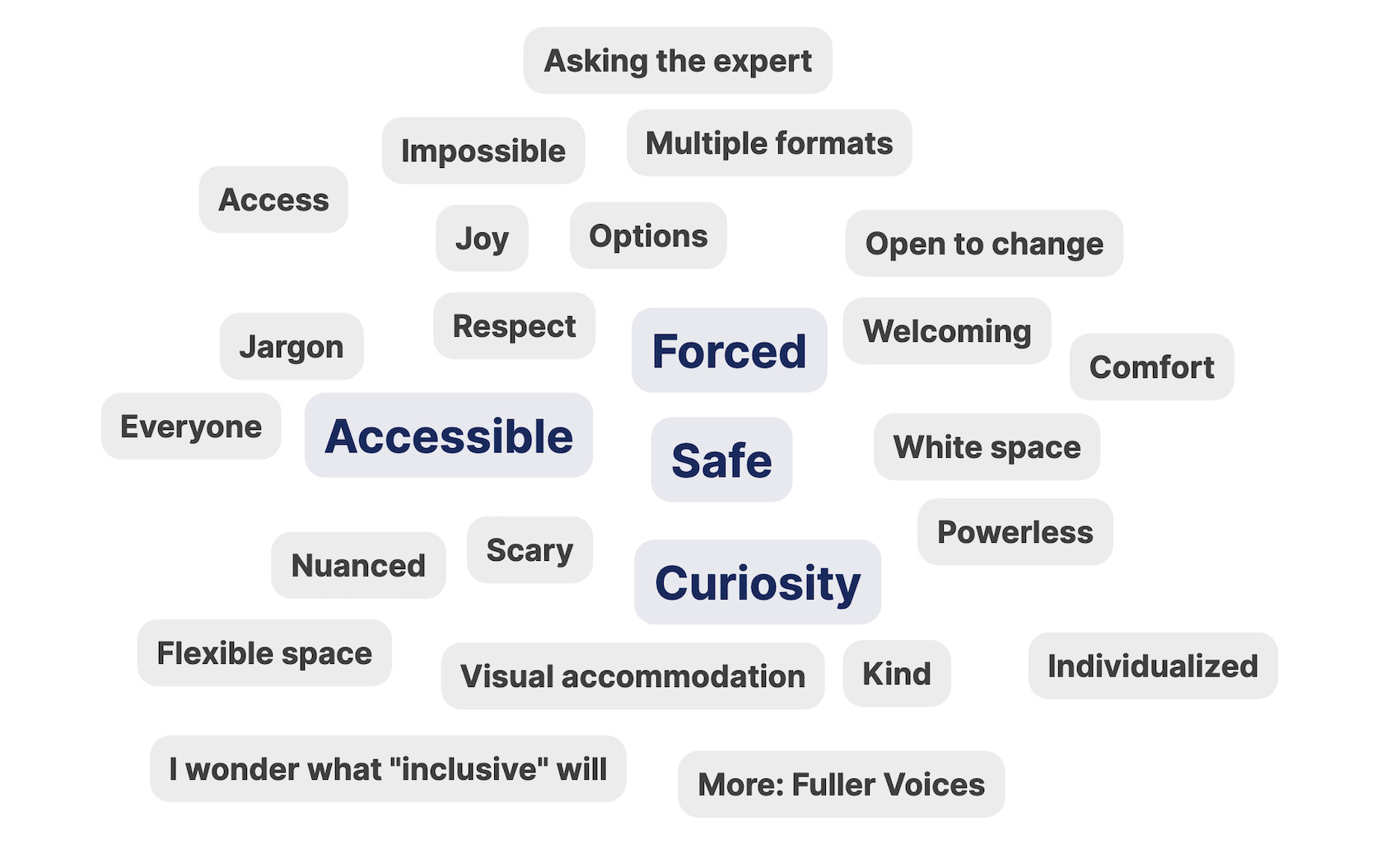
Following this first interactive response, participants were introduced to the workshop learning objectives and then offered definitions related to diversity and inclusion, embodiment, experiential learning, and UD. The presenters then outlined suggestions for creating a classroom culture of embodied inclusivity, offering the strategies outlined in the previous section. At this point, the second interactive prompt asked participants, “What comes to mind when you hear ‘inclusive classroom’?” The responses are generated in a word cloud format, seen as a visual representation below (Figure 1).
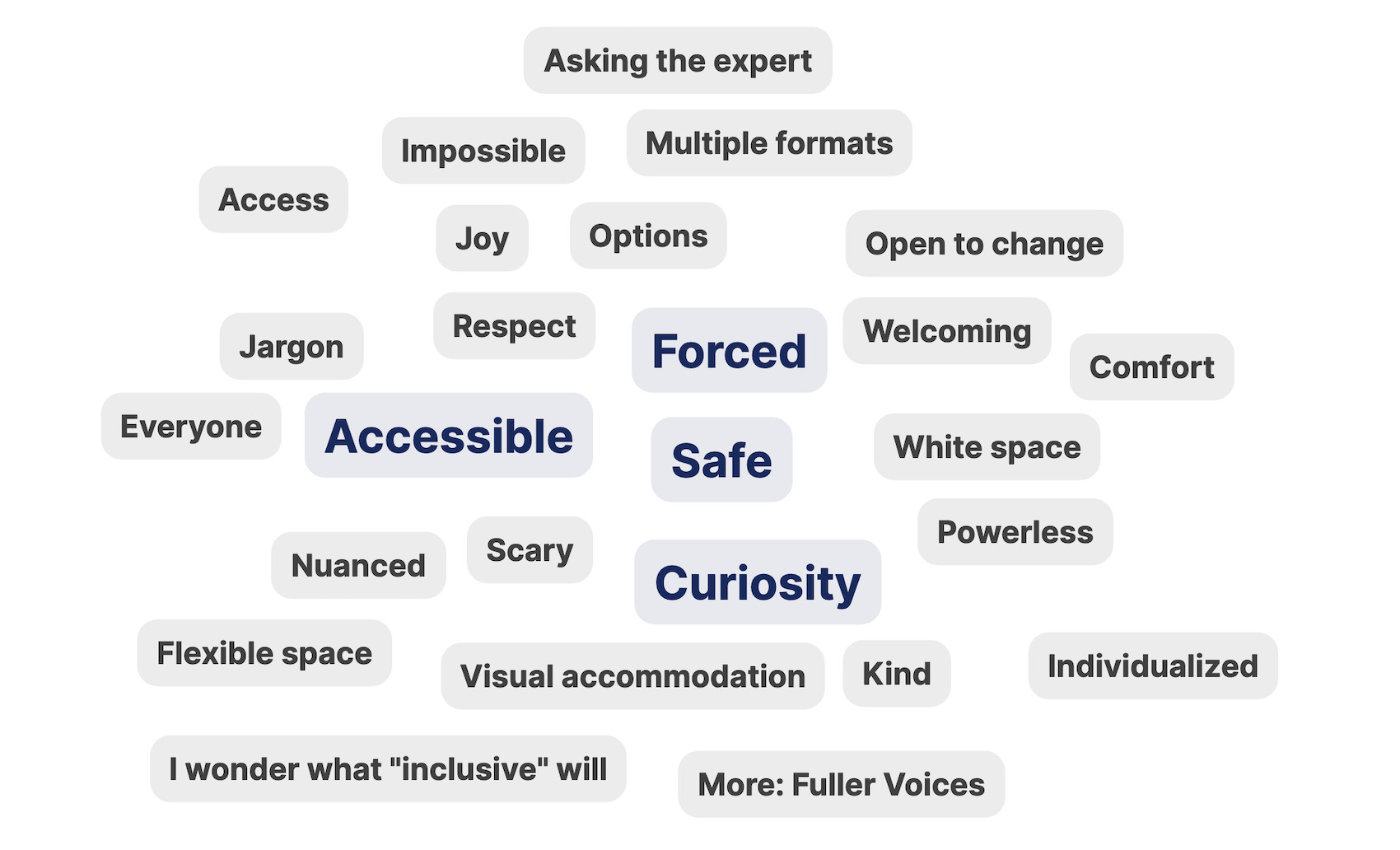
There were thirty-five total responses to the short answer questions. Responses are visually represented in a “word cloud” with larger words centered in the middle of all other responses. Words that appeared larger than others indicated multiple similar responses, and those terms included: accessible, forced, safe, and curiosity. Other responses, all the same smaller sized font, included: asking the expert, impossible, multiple formats, access, joy, options, open to change, jargon, respect, welcoming, comfort, everyone, white space, nuanced, scary, powerless, flexible space, visual accommodation, kind, individualized, more: fuller voices and finally, I wonder what “inclusive” will (this final response was likely cut off by a character limit for the responses).
A short discussion, led by facilitators and including all participants, followed this second interactive response. Following this, the facilitators outlined practical suggestions and strategies for integrating both embodiment and UD into the counselor education classroom. Participants were then asked to take a moment to reflect on two separate prompts. The first asked, “Can you remember a moment when you felt truly included in a classroom? What did that feel like? What did that look like? What part of that memory still lives in you now?” After some time to process, the second prompt was offered, inquiring, “Conversely, can you remember a moment when you did not feel included in a classroom? What did that feel like? What did that look like? What part of that memory still lives in you now?” Once again, participants were given time to reflect and process. Then, the final interactive slide opportunity was presented, asking participants to answer in short answer format, “What is one idea you are leaving with today that you plan to incorporate into your setting?” The eighteen responses are included in the table below.
This final prompt concluded the planned content for the workshop session. At this point, there was a question-and-answer session, and then participants were reminded to complete the necessary evaluation to receive their continuing education credits. In the question-and-answer session, participants shared enthusiasm and energy about integrating these practical strategies in their individual settings.
Discussion
By sampling other counselors, counselor educators, supervisors, and directors, we captured a glimpse into what academics think of when considering inclusivity, and what inclusive practices can look like in application. Though many participants offered different answers, several themes stood out upon analysis. The first was the interconnectedness of inclusivity, accessibility, and safety. Though our first question only asked about inclusivity, forms of accessibility and safety were repeatedly included in participants’ answers. This theme may indicate that inclusive and accessible environments might feel safer for all bodies, whether that is physical safety or psychological safety. Second, was the association of inclusion with feeling forced or rigid. In addition to the word “forced” coming up as one of the most common words in the map, the suggestions participants offered indicated that the alternative to rigidity would be beneficial, such as flexibility, inviting many forms of participation and offering more choices to students. The final theme we found was approaching the class with curiosity. “Curiosity” also arose in the word cloud and through participant responses regarding being curious about students’ needs and wants, consistently checking in with students, and using the strengths of having students in different bodies as a tool for learning.
Implications for Counselor Educators
The themes from this study offer applicable suggestions and andragogical strategies for counselor education classrooms. Concerning the lesson agendas, participants suggested using role plays as a form of embodiment, utilizing interactive learning technology (e.g., Slido) to engage students and allow anonymous and interactive contributions, offering opportunities for physical tools (e.g., fidgets, body movement), doing a mindful check-in at the beginning of class to demonstrate care for students and bring awareness to their own body, and being flexible with the class agenda as a way of being responsive to student needs (Paul, 2021). Regarding assignments, participants offered that choices be given to students (e.g., multiple activities that measure one objective) and relying less on using attendance as a measure of learning (DO-IT Center, n.d.; UDL on Campus, n.d.). Concerning physical materials, participants suggested using high color contrast in slideshows and offering different physical classroom setups (e.g., differing seating arrangements, allowing students to sit or stand) (DO-IT Center, n.d.; UDL on Campus, n.d.). Finally, several suggestions surround creating a welcoming and inclusive classroom environment: using bodies to support learning rather than stigmatize, reminding students to take care of their bodies (e.g., go to the bathroom or eat when they need to), using invitational language, and offering anonymous space for accommodations throughout the semester (Hrach, 2021; LeFeber et al., 2023). The participants of this study offered suggestions that have been suggested in literature before, but only in relation to UD or embodied learning. Though these recommendations have been thought of in isolation, by bringing these two theories together, participants offer unique perspectives on improving accessibility and inclusivity of counselor education classrooms.
While providing accommodating and welcoming classroom spaces takes a great deal of intentionality, these examples also demonstrate that the changes that need to be made are not extreme. Making simple accommodations, can leave a meaningful impact, particularly for students with disabilities (Roundtree, 2024). Just as we emphasize intersectionality in our lessons on working with clients, we need to hold a similar context for our students’ identities and make space for minoritized students in our classrooms.
Limitations & Future Studies
As presenters who do not appear to have disabled or marginalized identities, it is essential to acknowledge that different presenters may have facilitated different results. The limitations of this study mainly include a limited pool of participants and a small sample size. Participants had already opted into our workshop based on their interest in the topic and may have already had some training on either UD or embodied pedagogy/andragogy. Further, self-reporting has natural limitations, such as social desirability bias. Future research on the impact of UD and embodied learning from a student perspective could be beneficial, for example, an observational study in the classroom with survey components on effectiveness. Additionally, studying these approaches in doctoral classrooms could be helpful for future counselor educators.
Conclusion
Across the disciplines of both pedagogy and andragogy, history has not always emphasized approaches designed with minoritized students in mind, including but not limited to students with disabilities, students living with chronic pain/conditions, and students in bigger bodies. Counselor educators have the opportunity to increase inclusivity in and access to this field by intentionally addressing these topics and designing accessible classrooms. In a podcast discussion of her book, The Body is Not an Apology, Taylor stated, “bodies are not only the designators of oppression, but all oppression is enacted on the body,” (2018). By acknowledging and addressing the importance of embodied experiences in the classroom and through the implementation of UD, we are actively resisting educational approaches that could otherwise further marginalize students.